
COMMERCIAL · CAR DEALERSHIPS

Trench Drain Installation for Car Dealerships in Toronto & the GTA

Dealership drainage covers four different problems on one site — service bays, wash and detail bays, delivery lanes, and the customer-facing showroom entrance. Each one needs a different grate and a different discharge route.

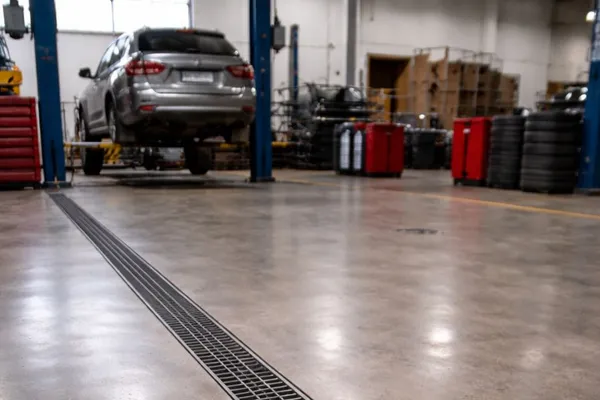
Trench drain installed at a car dealership service bay entrance
  • Since 1991 (35+ yrs)
  • Master Plumber Licensed
  • HomeStars Top Rated
  • Serving the GTA from Richmond Hill
The problem

Why car dealerships need trench drains

A dealership moves wet vehicles indoors all winter. Snow, brine, and wash water come off every car that enters, and it collects in the same places on every site — the service drive-through, the bay entries, and the wash bay floor.

  • Meltwater across the service drive

    Vehicles come in loaded with snow and road salt. It melts in the drive-through lane and pools where customers walk and technicians work, then refreezes overnight at the door line.

  • Wash bay water escaping the bay

    A wash or detail bay without proper containment sends water across the shop floor. It carries soap, solvent, and road grime into areas that were never meant to receive it.

  • Salt damage to the slab and finishes

    Standing brine attacks concrete, floor coatings, and anything steel at floor level. On a showroom floor it also leaves white staining that no amount of mopping removes.

  • Slip exposure in customer areas

    Water tracked into a showroom or customer walkway is a liability problem, not just a housekeeping one. Grate selection in those areas has to account for heels and mobility devices.

What we install

Built for car dealerships specifically

A dealership is not one drainage spec. Service and delivery bays take vehicle loads and need a heavy grate; wash bays need chemical resistance and an interceptor; the showroom entrance needs a grate that is safe underfoot and looks deliberate.

  • LOADClass C250 service bays / D400 delivery and truck routes
  • WIDTH100 - 200 mm depending on zone
  • MATERIALPolymer concrete through service and delivery areas; stainless in wash and detail bays where chemical exposure is constant
  • GRATEDuctile iron in bays; heel-safe slip-resistant stainless or galvanized at showroom and customer entrances

The single most important decision on a dealership site is not the channel — it is where each zone is allowed to discharge. Wash bay water and clean surface runoff do not go to the same place, and getting that wrong is a compliance problem rather than a performance one.

GRATE CHANNEL OUTLET →
Placement

The four drainage zones on a dealership site

Most dealerships need drainage in four distinct places, and treating them as one system is the usual mistake.

The service drive-through is where the volume is. Every vehicle entering in winter carries snow and brine that melts in the same twenty feet of floor. A channel across the drive-through entrance intercepts it at the door line before it reaches the bays or the customer waiting area.

The wash and detail bay is a separate system entirely. That water carries detergent, solvent, and hydrocarbons, so it is contained within the bay and routed through an oil and grit interceptor before it reaches sanitary. It never ties into the surface drainage that handles clean runoff from the lot.

Trench drain installed at a vehicle service bay entrance
Discharge routes by zone
  • Wash and detail bays: interceptor, then sanitary under the municipal sewer use by-law
  • Service bays and drive-through: interceptor where vehicle fluids are present
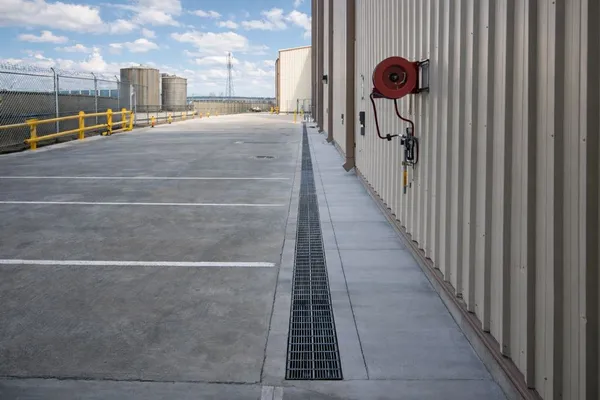
  • Lot and delivery areas: storm system, never sanitary
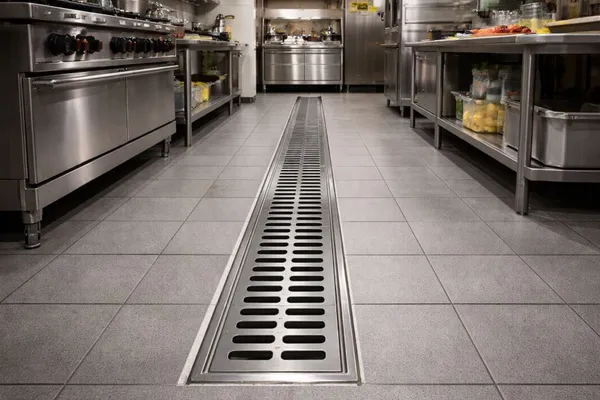
  • Showroom entrance: clean surface water to storm
Install Sequence

Installing without closing the dealership

A dealership cannot shut its service department for a week. We phase the work bay by bay so the shop keeps billing hours through the install.

  • Typical site time2-5 days
  • Bay downtimeOne at a time
  • Traffic back on24-72 hr cure
  1. 01

    Walk the site with the service manager

    We map where water actually collects across a winter day, confirm bay traffic and vehicle weights, and identify which zones share a discharge route and which must not.

  2. 02

    Confirm the interceptor and discharge approval

    Wash bay discharge to sanitary is governed by the municipal sewer use by-law and generally requires an oil and grit interceptor. We establish what is already installed and whether it is adequate before quoting.

  3. 03

    Phase the cut bay by bay

    One bay comes out of service at a time. The slab is cut, excavated, and the channel set to slope while the rest of the shop keeps running.

  4. 04

    Set channel and pour back

    The channel is set to grade on a proper base, tied to its approved outlet, and the slab poured back with the grate frame locked to the surrounding floor level.

  5. 05

    Cure, then return the bay

    Each bay is back in service after cure, typically 24 to 72 hours depending on mix and temperature. We give you the specific window per pour rather than a general figure.

Compliance

What a dealership install has to satisfy

Dealership drainage sits at the intersection of vehicle loading, chemical discharge, and a public-facing building. All three carry requirements.

By-law requirement

Oil and grit interceptor on wash bay discharge

Water leaving a wash or detail bay carries hydrocarbons and solids. Municipal sewer use by-laws across the GTA — Toronto Municipal Code Chapter 681 and the Peel, York, and Durham equivalents — set limits on what may enter sanitary. An interceptor sized for the bay is normally required, and it needs a maintenance schedule to stay compliant.
By-law restriction

Wash water to the storm system

Detergent and hydrocarbon-bearing water is restricted from entering the storm drainage that serves the lot. Storm discharge goes to a watercourse largely untreated, which is why it is restricted under municipal and provincial environmental requirements.

Customer areas

Heel-safe grates where the public walks

A showroom entrance or customer walkway needs a grate rated for pedestrian safety, not just load. Slot widths that catch a heel or a mobility device are an accessibility and liability issue under Ontario accessibility expectations.

Load class

Delivery lanes take more than cars

Car carriers and delivery trucks cross the same apron as customer vehicles. Grates rated for passenger traffic fail quickly under a loaded transporter, so delivery routes get D400 rather than the C250 that suits a service bay.

Typical cost

Fixed quote after site visit

Dealership pricing depends on how many zones are involved, whether an interceptor already exists and is adequate, slab thickness, and how much of the work has to happen outside operating hours.

What changes the price

  • Number of zones — service, wash, delivery, showroom
  • Existing interceptor capacity and condition
  • Load class required per zone
  • Slab thickness and reinforcement
  • Phasing and after-hours work to keep bays open
  • Stainless specification in wash and detail areas

Get a fixed-price quote after a free site visit — not a range.

FAQ

Common questions about car dealerships

Can you install without shutting the service department?

Yes, and that is how these jobs are normally run. We phase bay by bay so only one is out of service at a time and the shop keeps billing hours. Where a zone cannot come out of service at all during the day, we schedule that section for evenings or a weekend. The sequence is agreed with your service manager before the first cut.

Does our wash bay need an oil and grit interceptor?

Almost certainly, if it discharges to sanitary. Municipal sewer use by-laws across the GTA set limits on hydrocarbons and solids entering the sanitary system, and a wash bay produces both. Many dealerships have an interceptor that was sized for a smaller operation or has not been maintained. We check what is installed and whether it is adequate before designing the drain into it.

Can wash bay water go to the storm drain instead?

No. Storm drainage discharges to a watercourse with little or no treatment, so detergent and hydrocarbon-bearing water is restricted from entering it under the applicable by-law. This is set by the by-law rather than by preference.

What load class do dealership drains need?

It varies by zone, which is why a single site spec does not work. Service bays generally take C250. Delivery lanes and any route a car carrier crosses need D400, because a grate rated for passenger vehicles fails quickly under a loaded transporter. We spec each zone for the traffic it actually sees.

What about the showroom entrance — will a drain look industrial?

Not if it is specified for the setting. Customer-facing entrances take a slot or narrow-profile grate in stainless or architectural finish, chosen to be heel-safe and slip-resistant as well as presentable. That is a different part from what goes in a service bay, and it should be.

Our drive-through floods every thaw. Is one channel enough?

Usually yes, if it is placed at the door line rather than further in, and if the outlet can take the volume. The failure we see most often is a channel set where it was easy to cut instead of where the water actually arrives, so meltwater passes it and reaches the bays anyway.

How long before we can drive on the new pour?

Typically 24 to 72 hours depending on the mix and the shop temperature. We give you the specific window for each pour before leaving, and we would rather quote an honest 72 hours than an optimistic 24 that cracks under a transporter.

Do you handle multi-store dealership groups?

Yes. Where a group has several rooftops across the GTA we quote them together and standardise the specification across sites, which makes maintenance and grate replacement simpler later. Each site still gets its own site visit — discharge routes are never identical.

Licensed & insured · Serving the GTA since 1991

Installed by TroughDrain.ca, a division of MT Drains & Plumbing Ltd.

  • Master Plumber Licence #T95-5349719
  • Plumbing Contractor #T94-5214638
  • Building Renovator #T85-4544391

Need a trench drain spec'd or installed?

Free site visit across the GTA. We'll tell you what you actually need — no upsell.

Call (647) 558-4885