COMMERCIAL · FACTORIES & MANUFACTURING

Trench Drain Installation for Factories & Manufacturing Plants

Factory drainage is a discharge compliance question before it is a drainage question. What is in the water decides the material, the interceptor, and whether the plant needs a sewer discharge agreement.

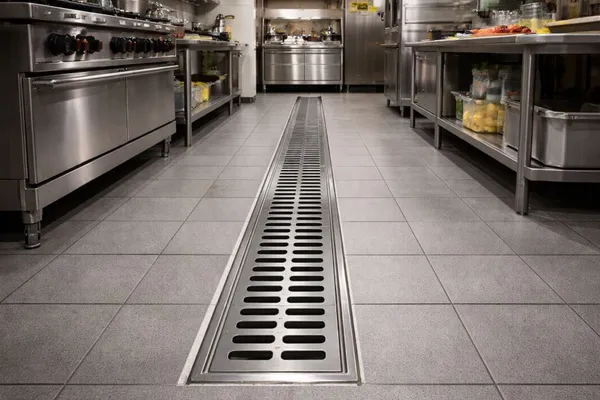
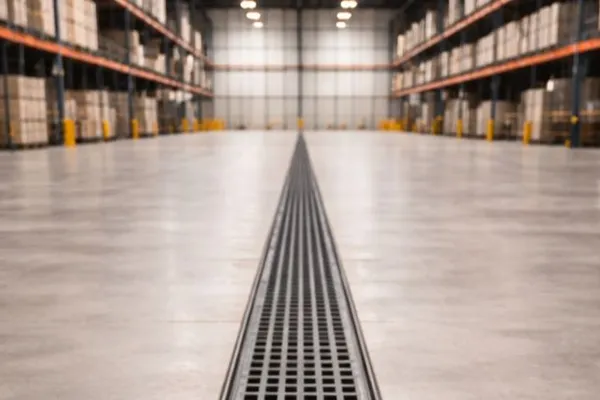
Heavy-duty trench drain across an industrial production floor
  • Since 1991 (35+ yrs)
  • Master Plumber Licensed
  • HomeStars Top Rated
  • Serving the GTA from Richmond Hill
The problem

Why factories and manufacturing plants need trench drains

A production floor generates water continuously and in specific places — wash-down aisles, process lines, cooling equipment, and the overhead doors where forklifts and trucks bring weather inside. A point drain cannot keep up with a linear wet zone.

  • Standing water along process lines

    Wash-down and process water collects in the same band of floor every shift. It sits because the slab was poured flat and there is nowhere linear for it to go.

  • Grates failing under forklift traffic

    Forklifts are brutal on drainage. A grate rated for vehicles fails fast under hard small wheels and point loading, and a loose grate in a traffic aisle becomes a serious hazard.

  • Chemical attack on the channel

    Process effluent that is acidic, alkaline, or hot degrades the wrong channel material quickly. A drain specified without knowing the effluent chemistry is a drain with a short life.

  • Discharge that is not compliant

    Process water entering sanitary without adequate pretreatment puts the facility offside the municipal sewer use by-law. That is an enforcement and cost exposure, not just a plumbing detail.

What we install

Built for factories & manufacturing specifically

The specification follows the effluent. Before anything else we establish what is in the water, how hot it is, and where it is legally allowed to go — and only then choose a channel, a grate, and a frame.

  • LOADClass E600 general production / F900 heavy equipment and dock aprons
  • WIDTH150 - 300 mm depending on volume
  • MATERIALPolymer concrete for general production; stainless 304 or 316 where effluent is aggressive, hot, or subject to hygienic requirements
  • GRATEDuctile iron, bolted or locked down, with a galvanized or stainless edge rail in forklift traffic

In forklift aisles the edge rail matters more than the grate. Hard small wheels hammer the channel edge, and an unprotected polymer edge will spall within a year. Bolted-down grates are not optional where traffic is constant.

GRATE CHANNEL OUTLET →
Placement

Where drainage belongs on a production floor

Placement follows where water is generated and where traffic crosses — which are frequently the same line, and that conflict is the design problem.

Wash-down aisles and process lines get a channel running the length of the wet zone rather than a point drain at one end. The channel is set with built-in fall so it clears fast between shifts instead of holding standing water that has to evaporate.

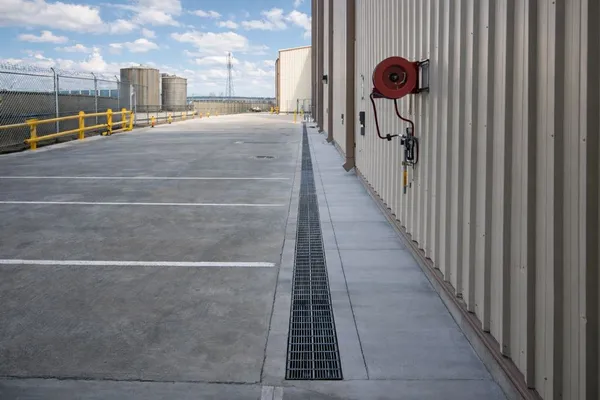
Overhead doors and dock aprons are the other constant. A channel across the opening intercepts weather and melt carried in by forklifts and trucks before it reaches the production floor, and that location takes the heaviest loading on the site.

Heavy-duty trench drain installed across an industrial production floor
Discharge routes by water type
  • Process effluent — pretreatment, then sanitary under a discharge agreement
  • Wash-down water — interceptor sized to the contaminant, then sanitary
  • Clean surface runoff at doors — storm system
  • Never: process effluent to storm, under any circumstances
Install Sequence

Installing without stopping production

Production downtime costs more than the drain. We phase by aisle or cell and work to your maintenance windows, including weekends and shutdowns.

  • Typical site time2-6 days
  • Floor downtimeBy aisle or cell
  • Traffic back on48-72 hr cure
  1. 01

    Establish the effluent and the discharge route

    Before any layout we confirm what the water contains, its temperature, where it currently goes, and whether the facility holds a sewer discharge agreement. This decides material and interceptor requirements.

  2. 02

    Map wet zones against traffic

    We record where water is generated each shift and what crosses it — forklift routes, pallet jacks, heavy equipment — because the grate and frame are specified for the traffic, not the water.

  3. 03

    Phase by aisle or production cell

    The floor is cut in sections so production continues around the work. Where a cell cannot stop at all, that section moves to a scheduled maintenance window or a shutdown.

  4. 04

    Set channel, frame, and edge protection

    The channel is set to fall on a proper base with the frame anchored into the slab and edge rails fitted where forklift traffic demands them. Grates are bolted down in traffic aisles.

  5. 05

    Cure to spec before traffic returns

    Industrial pours take longer to reach traffic strength than a residential driveway. We specify the cure window per pour and hold to it — an early forklift crossing is how a new install fails in month one.

Compliance

Discharge, materials, and load — in that order

Industrial drainage gets specified backwards more often than any other application. The effluent decides everything downstream of it.

Established first

Sewer discharge agreements

Municipal sewer use by-laws across the GTA — Toronto Municipal Code Chapter 681 and the Peel, York, and Durham equivalents — set limits on what industrial operations may discharge to sanitary. Depending on the effluent a facility may need pretreatment, monitoring access, or a formal discharge agreement. This is established before the drain is designed, not after.
By-law restriction

Process effluent to the storm system

Storm drainage discharges to a watercourse with little or no treatment. Routing process water there is restricted under municipal and provincial environmental requirements, and we do not install it.

Material choice

Match the channel to the chemistry

Acidic, alkaline, or hot effluent degrades the wrong material quickly. Polymer concrete handles a wide range but not everything; stainless 316 handles far more at higher cost. Specifying without knowing the chemistry produces a drain that fails early.

Load class

Forklifts punish drainage harder than trucks

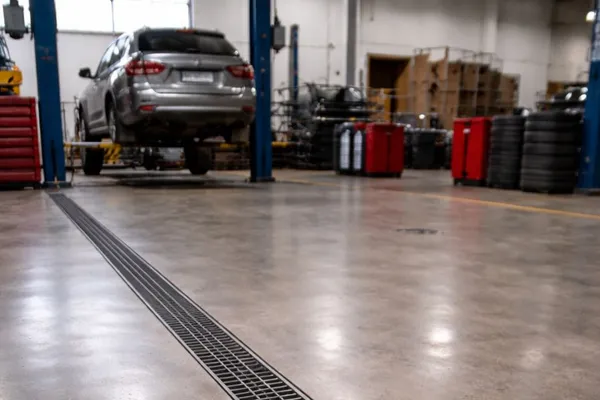
Small hard wheels concentrate load onto a tiny contact patch and hammer the channel edge on every pass. Production aisles get E600 or F900 with bolted grates and edge protection, which is a higher spec than most people expect for an indoor floor.

Typical cost

Fixed quote after site visit

Industrial pricing is driven by effluent requirements, load class, and how much of the work has to fit inside maintenance windows. We quote after establishing the discharge route, because that decides the material and it is the largest single variable.

What changes the price

  • Effluent chemistry and temperature
  • Interceptor or pretreatment requirements
  • Load class — E600 or F900
  • Stainless versus polymer concrete channel
  • Slab thickness, reinforcement, and services below
  • Phasing around production and shutdown windows

Get a fixed-price quote after a free site visit — not a range.

FAQ

Common questions about factories & manufacturing

What do you need to know before quoting a plant?

What is in the water, how hot it is, and where it currently goes. Effluent chemistry decides the channel material, the interceptor requirement, and whether the discharge is compliant at all. A quote produced without that is a guess, and it is the reason industrial drains get specified wrong and fail early.

Do we need a sewer discharge agreement?

It depends on what you discharge and in what volume. Municipal sewer use by-laws across the GTA set limits on industrial discharge to sanitary, and depending on the effluent a facility may need pretreatment, sampling access, or a formal agreement with the municipality. We establish where you stand before designing the drain into an existing connection.

Can process water go to the storm drain?

No, and the by-law does not provide for it. Storm drainage discharges to a watercourse largely untreated. Routing process effluent there is restricted under municipal and provincial environmental requirements. If your current setup does this, that sits outside what the applicable by-law permits, independently of any new drainage work.

Why do forklifts need a higher load class than trucks?

Because of the contact patch. A forklift concentrates a heavy load onto small hard wheels, which hammers the channel edge on every crossing rather than distributing across a pneumatic tyre. Production aisles typically need E600 or F900 with bolted grates and a galvanized or stainless edge rail — a higher spec than most people expect for an indoor floor.

Our existing drain edges are crumbling. Why?

Almost always unprotected channel edges under forklift traffic. Hard wheels spall an unprotected polymer edge within a year or two, and once the edge goes the grate starts rocking, which accelerates everything. The fix is an edge rail and a properly anchored frame, not simply a new grate.

Can you work around production?

Yes. We phase by aisle or production cell so the floor keeps running around the work, and where a cell cannot stop at all we schedule that section into a maintenance window or a planned shutdown. The sequence is agreed with your maintenance lead before we start.

How long before forklifts can cross a new pour?

Longer than a driveway — typically 48 to 72 hours depending on mix and plant temperature, and sometimes more for a high-strength pour. We specify the window per pour and hold to it. An early crossing is the single most common way a correctly specified industrial install fails in its first month.

Do you handle food and beverage processing plants?

Yes, and those have their own requirements. Hygienic processing areas need stainless channel with radiused internal corners, fully removable grates, and a profile designed to be cleaned rather than merely drained. Those jobs are specified around the sanitation regime as much as the water volume.

Licensed & insured · Serving the GTA since 1991

Installed by TroughDrain.ca, a division of MT Drains & Plumbing Ltd.

  • Master Plumber Licence #T95-5349719
  • Plumbing Contractor #T94-5214638
  • Building Renovator #T85-4544391

Need a trench drain spec'd or installed?

Free site visit across the GTA. We'll tell you what you actually need — no upsell.

Call (647) 558-4885