
COMMERCIAL · CAR WASHES

Trench Drain Installation for Car Washes in Toronto & the GTA

A car wash is the one commercial building where drainage is the process, not a service to it. Volume, grit, chemistry, and reclaim all run through the same channel — and the sewer use by-law decides what may leave the site.

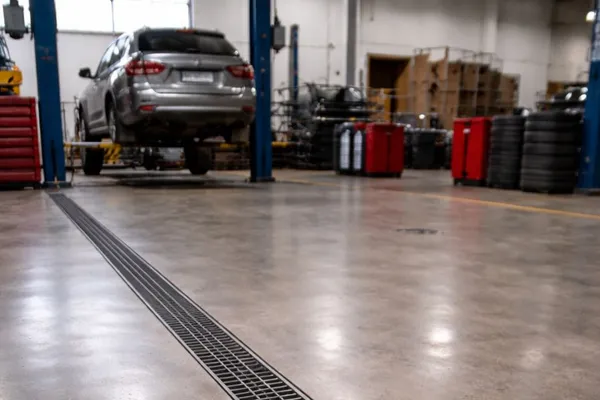
Heavy-duty trench drain installed in a vehicle wash bay
  • Since 1991 (35+ yrs)
  • Master Plumber Licensed
  • HomeStars Top Rated
  • Serving the GTA from Richmond Hill
The problem

Why car washes need purpose-built trench drainage

Every other commercial building treats water as something to remove. A car wash generates it deliberately, at high volume, loaded with grit, detergent, and hydrocarbons — and most of it is meant to be recovered rather than discharged.

  • Grit filling the channel

    Sand, road salt, and brake dust come off every vehicle and settle in the drain. Silt is the number one reason a car wash drain stops performing, and it happens far faster than owners expect.

  • Corroded channel and grates

    Constant wet plus high-pH detergent plus winter chloride is an aggressive environment. Standard galvanized parts that would last a decade elsewhere fail here in a couple of seasons.

  • Water escaping the bay

    Wash water reaching the lot or the apron is water that is no longer recoverable, and depending where it goes it may also be a discharge offence.

  • Freezing at the bay entrance

    In a GTA winter the entrance and exit of a wash bay ice up first. A drain that freezes solid backs water into the bay and stops the operation until it thaws.

What we install

Built for car washes specifically

Car wash drainage is specified around three things at once: the volume passing through, the abrasive and chemical load carried in it, and the reclaim system it has to feed. Getting any one wrong shortens the life of the whole installation.

  • LOADClass C250 through bays and tunnels / D400 at entry and exit aprons
  • WIDTH150 - 300 mm depending on throughput
  • MATERIALStainless 304 as a baseline, 316 where chloride and detergent exposure is heaviest; polymer concrete acceptable on exterior aprons
  • GRATEHeavy-duty slotted stainless or ductile iron, removable for daily grit clearing, slip-rated in self-serve bays where customers walk

Design for sediment removal before design for flow. A car wash channel needs accessible catch basins with sediment baskets ahead of the interceptor, because grit that reaches the separator degrades its performance and grit that reaches a reclaim tank ends up back on somebody’s paint.

GRATE CHANNEL OUTLET →
Placement

Where drainage goes in a wash facility

Layout differs sharply between a conveyor tunnel, an in-bay automatic, and a row of self-serve wand bays — but the sequence downstream of the channel is always the same.

In a conveyor tunnel the channel runs the length of the wash, usually offset from the conveyor track, catching water continuously along the run rather than at one low point. Fall has to be built into the channel itself on a long tunnel, because you cannot slope a forty-metre slab enough to do it any other way.

In-bay automatics and self-serve bays are simpler geometry but harsher duty. Each bay drains to its own channel and every one of them needs to be clearable without shutting the neighbouring bays, which means removable grates and accessible sediment baskets rather than a sealed system.

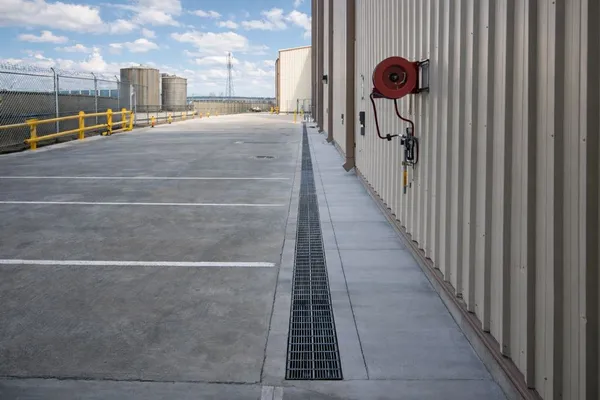
Heavy-duty trench drain installed in a vehicle wash bay
The sequence every wash needs
  • Channel with built-in fall along the wash run
  • Catch basin with a sediment basket for grit capture
  • Oil, grit and sand interceptor sized to throughput
  • Reclaim tank draw-off, or sanitary under the sewer use by-law
Install Sequence

Installing without closing the wash

A wash that is closed earns nothing, so we phase bay by bay wherever the layout allows it. A conveyor tunnel is the exception — that is usually a scheduled shutdown.

  • Typical site time3-7 days
  • Bay downtimeOne at a time
  • Traffic back on48-72 hr cure
  1. 01

    Establish throughput and the reclaim setup

    Vehicles per day, water per vehicle, and whether the site reclaims or discharges everything. That decides channel width, interceptor sizing, and where the drain has to deliver to.

  2. 02

    Confirm the interceptor and by-law position

    Wash discharge to sanitary is governed by the municipal sewer use by-law. We establish what interceptor is installed, whether it is sized for actual throughput, and whether it has been maintained.

  3. 03

    Phase by bay, or schedule the tunnel shutdown

    Self-serve and in-bay layouts come out one at a time so the site keeps trading. A conveyor tunnel generally needs a planned closure, which we book with you well ahead.

  4. 04

    Set stainless channel with built-in fall

    The channel is set on a proper base with fall built in along the run, catch basins positioned for access, and the frame anchored so grates do not work loose under constant wet loading.

  5. 05

    Cure, commission, and hand over the clean-out routine

    We walk your staff through daily grit clearing and the interceptor service interval before we leave. On a wash site the maintenance routine is the difference between a ten-year drain and a two-year one.

Compliance & durability

What a car wash install has to get right

Four decisions determine whether a wash drain lasts. Three of them are made before anyone cuts concrete.

By-law requirement

Oil, grit and sand interceptor

Wash water carries hydrocarbons, detergent, and heavy solids. Municipal sewer use by-laws across the GTA — Toronto Municipal Code Chapter 681 and the Peel, York and Durham equivalents — set limits on what may enter sanitary, and a correctly sized interceptor with a real maintenance schedule is how a wash stays compliant.
By-law restriction

Wash water to the storm system

Storm drainage reaches a watercourse largely untreated. Detergent and hydrocarbon-bearing wash water is restricted from entering it under the applicable by-law. On a car wash site this is the single most consequential mistake available, and it is one inspectors look for specifically.

Material

Chloride and detergent decide the grade

Winter brine coming off vehicles plus high-pH detergent is harder on metal than almost any other commercial setting. Stainless 304 is the sensible baseline and 316 earns its cost where exposure is heaviest. Standard galvanized parts do not survive here.

Design consideration

Sediment capture ahead of everything

Grit is the defining maintenance problem of a wash site. Accessible catch basins with removable sediment baskets ahead of the interceptor keep solids out of the separator and out of a reclaim tank. A system that cannot be cleared daily will not be cleared at all.

Typical cost

Fixed quote after site visit

Car wash pricing is driven by throughput, stainless specification, and interceptor requirements more than by channel length. We establish the discharge and reclaim position before quoting, because it decides the material.

What changes the price

  • Format — tunnel, in-bay automatic, or self-serve bays
  • Vehicles per day and water per vehicle
  • Stainless grade — 304 or 316
  • Existing interceptor capacity and condition
  • Reclaim system integration
  • Phasing to keep bays trading during the install
  • Freeze protection at entry and exit

Get a fixed-price quote after a free site visit — not a range.

FAQ

Common questions about car washes

Why does our drain silt up so fast?

Because a car wash concentrates in one channel all the grit, sand, and road salt that would otherwise be spread across a parking lot. This is normal and expected — the failure is a system that was not designed to have it removed. You need accessible catch basins with sediment baskets ahead of the interceptor, and a daily clearing routine. A sealed channel with no clean-out access will silt up and stay silted up.

Do we need an oil and grit interceptor?

If you discharge to sanitary, effectively yes. Municipal sewer use by-laws across the GTA set limits on hydrocarbons and suspended solids entering the sanitary system, and wash water carries both in quantity. Many sites have an interceptor sized for a lower throughput than they now run, or one that has not been pumped on schedule. We check capacity and condition before designing into it.

Can wash water go to the storm drain?

No, and this is the one to be absolutely clear on. Storm drainage discharges to a watercourse with little or no treatment, so detergent and hydrocarbon-bearing water is restricted from entering it under the applicable by-law. It is restricted under municipal and provincial environmental requirements, and wash sites are routinely reviewed against them. If your current setup does this, it sits outside what the applicable by-law permits, independently of any new drainage work.

Stainless or polymer concrete?

Stainless inside the wash, in almost every case. The combination of constant wet, high-pH detergent, and winter chloride off vehicles is more aggressive than nearly any other commercial environment. 304 is the sensible baseline; 316 earns its extra cost where chloride exposure is heaviest. Polymer concrete is fine on exterior aprons where the duty is much lighter.

How do you build fall into a long tunnel?

Into the channel, not the slab. You cannot slope a forty-metre floor enough to clear water without creating a serious step, so the fall is built into the channel run itself — either by stepping invert depth along the run or by using a sloped channel system. A long tunnel drain set flat holds standing water down its entire length.

Will the drain freeze in winter?

The entrance and exit are the exposure points and they need to be planned for. A channel that freezes backs water into the bay and stops the operation until it thaws. Depending on the layout that means heat tracing, routing the vulnerable section to a warmer discharge, or adjusting placement so the most exposed run is not the one carrying everything.

Can you install without closing us?

For self-serve and in-bay automatic layouts, yes — bays come out one at a time and the site keeps trading. A conveyor tunnel usually needs a planned shutdown, because the channel runs the length of the wash and the conveyor has to come out of service. We book that well ahead so you can plan around the lost days.

How does this work with our reclaim system?

The drain feeds it, so the two get designed together. Grit reaching a reclaim tank ends up recirculated and back on a customer’s paint, which is why sediment capture ahead of the draw-off matters more on a reclaim site than a discharge one. We confirm how your reclaim is configured before setting catch basin positions.

Licensed & insured · Serving the GTA since 1991

Installed by TroughDrain.ca, a division of MT Drains & Plumbing Ltd.

  • Master Plumber Licence #T95-5349719
  • Plumbing Contractor #T94-5214638
  • Building Renovator #T85-4544391

Need a trench drain spec'd or installed?

Free site visit across the GTA. We'll tell you what you actually need — no upsell.

Call (647) 558-4885