
Exterior drains tied to private drainage
Tying into your existing private storm line, sump discharge, or a dry well normally needs no separate City of Toronto permit for the drain itself.
Narrow lots, mutual drives, and pre-war housing — East York drainage is a precision job more often than a big one.
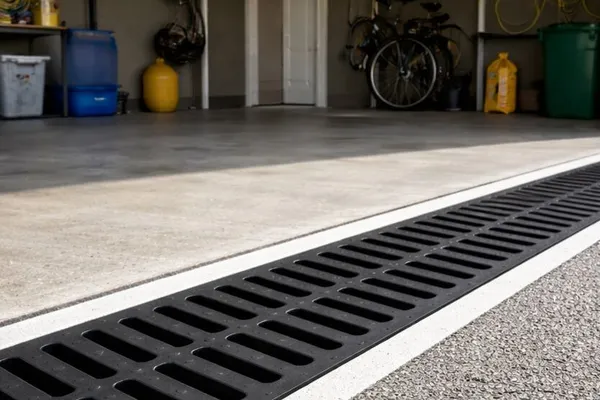
East York is pre-war and tightly built. Lots are narrow, driveways are often mutual, and access is the constraint that shapes most jobs here far more than the drainage calculation does.
Six on-site steps from the first cut to a flush, water-tight finish. Same sequence on every job — what changes is length, materials, and crew size.


Shared drive, eighteen inches of clearance either side. They got a channel in without touching the neighbour’s half.
East York is part of the City of Toronto, so Toronto Water rules and the Basement Flooding Protection Subsidy apply. Two local realities shape the work more than the paperwork does: combined sewers under the older streets, and shared driveways.
Tying into your existing private storm line, sump discharge, or a dry well normally needs no separate City of Toronto permit for the drain itself.
Significant stretches of pre-war East York still run combined storm-and-sanitary lines. Properties on those lines cannot legally discharge surface water to the public side without specific Toronto Water approval, so the outlet is decided before any concrete is cut.
A mutual drive is legally shared, and work on it can require your neighbour’s agreement as well as care about where water ends up. We keep the channel and the discharge on your side of the line, and we raise the question early rather than after a dispute.
Municipal sewer use by-laws govern what may enter the sanitary sewer, and surface water is restricted under them. On combined-era infrastructure this is exactly how a storm ends up in your basement. We do not install it.
East York is 30 to 50 minutes from our Richmond Hill shop and sits on our standing Toronto rotation. Access here is tighter than most of the GTA, so we scope parking and equipment placement at the site visit rather than assuming it.
Site visits are booked in fixed windows. The crew that quotes the job installs it. Most residential installs are a single day on site, then 24 to 48 hours of cure.
Usually yes, with care. A mutual drive is legally shared, so we keep the channel and the discharge on your side and we are careful not to route water toward your neighbour. Depending on the arrangement, their agreement may be needed. We raise it at the quote rather than discovering it mid-job.
Usually not for the drain itself when we tie into existing private drainage on your property. A new municipal storm connection requires a Toronto Water permit. On combined-sewer streets the outlet options are narrower, which is the real constraint here rather than the permit.
It is a single pipe carrying both storm water and sewage, common under pre-war Toronto streets including much of East York. It matters because you cannot legally add surface water to it without specific Toronto Water approval, and because during heavy rain a combined system is already at capacity. We route to private storm, a sump discharge, or a yard outlet instead.
Almost always. Narrow East York lots need a narrower channel and more careful placement rather than a bigger installation. The constraint is usually getting equipment in, not fitting the drain. We assess access at the site visit, because a job that needs hand excavation prices differently than one a machine can reach.
Yes. East York is part of the City of Toronto and eligible properties access the same Basement Flooding Protection Subsidy for backwater valves, sump pumps, and downspout disconnection. A trench drain alone does not qualify, though it can sometimes sit inside a wider eligible scope.
Residential installs fall in the $1,800 to $4,500 GTA range and East York jobs are often at the shorter, lower end because the runs are short. What pushes them up is access — hand excavation on a tight lot costs more labour than a machine on an open driveway.
Only if the water is arriving over the surface. If it comes up through a floor drain, that is sewer backup and you need a backwater valve, not a trench. We diagnose which one you actually have before quoting, and we will tell you when a drain is the wrong purchase.
Saw-cutting is loud for a couple of hours in the morning and produces slurry we contain and clean up. On a tight East York lot we agree material staging and parking with you before the day starts, because there is rarely spare room to improvise.
Free site visit across the GTA. We'll tell you what you actually need — no upsell.