
COMMERCIAL · FOOD & BEVERAGE PROCESSING

Hygienic Trench Drain Installation for Food & Beverage Plants

In a food plant the drain is the most heavily swabbed surface in the building. Hygienic design is not a finish upgrade here — it is what keeps a drain from becoming the harbourage site that shows up in your environmental monitoring results.

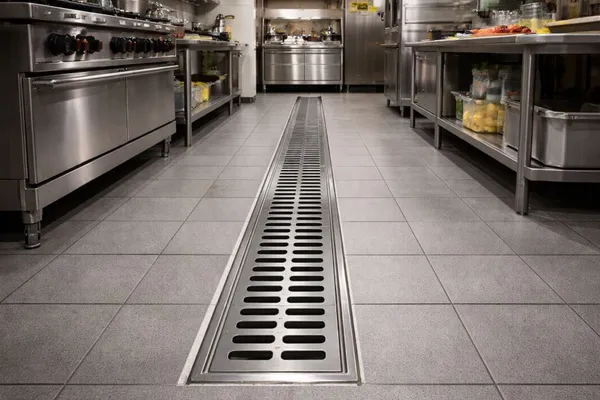
Stainless hygienic trench drain in a food processing area
  • Since 1991 (35+ yrs)
  • Master Plumber Licensed
  • HomeStars Top Rated
  • Serving the GTA from Richmond Hill
The problem

Why food and beverage plants need hygienic trench drainage

Processing floors are wet by design and sanitised on a fixed cycle. A drain that cannot be fully cleaned becomes the place organisms survive between washdowns — which is precisely why drains are the primary target of an environmental monitoring programme.

  • Positives tracing back to the drains

    Drains are the number one environmental monitoring hotspot in food processing. Seams, rough surfaces, and unremovable grates create harbourage that survives a normal sanitation cycle.

  • Standing water between shifts

    A channel without built-in fall holds water after washdown. Standing water in a processing environment is both a hygiene problem and a slip hazard on every shift that follows.

  • Channel degraded by CIP chemistry

    Clean-in-place cycles run hot and alternate caustic and acid. Materials that handle ordinary washdown fail quickly under repeated thermal and chemical cycling.

  • Surcharge on high-strength discharge

    Effluent heavy in fats, oils, grease, or organic load attracts municipal surcharges. Poor solids capture at the drain turns that into an ongoing operating cost rather than a one-time engineering decision.

What we install

Built for food & beverage processing specifically

Everything in a processing area is specified around cleanability. The channel has to be sanitised to the same standard as the equipment above it, drain fully between cycles, and survive hot caustic and acid without degrading.

  • LOADClass C250 processing floors / E600 where forklift traffic crosses
  • WIDTH100 - 300 mm; slot drain where floor space is tight
  • MATERIALStainless 304 as standard; 316 for brine, dairy, acid, and high-chloride processes
  • GRATEFully removable slotted or ladder grate, anti-slip rated, liftable by one person for daily sanitation

Radiused internal corners, continuously welded seams, and built-in fall are the three details that separate a hygienic channel from an industrial one with a stainless finish. A square internal corner is a harbourage point no sanitation crew can reliably reach.

GRATE CHANNEL OUTLET →
Placement

Where drainage belongs on a processing floor

Placement is a sanitation decision as much as a drainage one. The channel goes where water is generated, but never directly under exposed product.

Processing and washdown zones take a channel running the length of the wet area with fall built into the invert, so the floor clears completely between sanitation cycles instead of holding water until it evaporates. Where floor space is tight or equipment is dense, a slot drain gives the same capacity with a much smaller surface opening to clean.

The placement rule that overrides drainage convenience is keeping the channel out from directly beneath exposed product lines. Aerosol generated during high-pressure washdown travels, and a drain positioned under an open line is a contamination pathway that no amount of cleaning discipline fixes.

Stainless hygienic trench drain installed in a food processing area
Discharge sequence
  • Channel with built-in fall, radiused corners, removable grate
  • Catch basin with solids basket at the collection point
  • Grease and solids interceptor sized to the process load
  • Sanitary under the municipal sewer use by-law, with sampling access where required
Install Sequence

Installing around a production schedule

Processing floors come with a sanitation window and a production schedule that cannot slip. We work inside them, including weekends and planned shutdowns.

  • Typical site time3-7 days
  • Floor downtimeBy zone or line
  • Back in production48-72 hr cure
  1. 01

    Establish the process, the effluent, and the sanitation regime

    What runs on the floor, what the effluent carries, how hot the CIP cycles are, and what chemistry they use. That decides stainless grade, channel geometry, and interceptor requirements before any layout work.

  2. 02

    Confirm the discharge position

    High-strength effluent is subject to municipal sewer use limits and surcharge. We establish where the plant stands, what interceptor exists, and whether sampling access is required.

  3. 03

    Plan the zone shutdown with production and QA

    A processing area coming out of service needs sign-off from production and quality. Containment, access routing, and the post-work sanitation plan are agreed before the first cut.

  4. 04

    Set stainless channel to fall

    The channel is set on a proper base with fall built into the invert, frames anchored flush to the finished floor, and seams finished so there is no lip or gap at the floor junction.

  5. 05

    Sanitation sign-off before production resumes

    The area is cleaned and released back through your own sanitation and verification process. We build the cure window into the schedule rather than discovering it conflicts with a production restart.

Hygienic design

What separates a hygienic drain from a stainless one

Plenty of drains are made of stainless. Far fewer are designed to be cleaned, and in a food plant that distinction shows up in your swab results.

Design consideration

Drains are the primary monitoring hotspot

In a food processing environment, floor drains are the most sampled surface in the building and the most common source of environmental positives. Radiused internal corners, continuously welded seams, and a fully removable grate are what make a channel reachable by a sanitation crew rather than merely rinsable.
Design requirement

The channel must self-drain

Fall has to be built into the invert so the channel empties completely between sanitation cycles. Standing water in a processing area is a hygiene risk before it is a slip risk, and a flat channel holds it every single shift.

Material

CIP chemistry decides the grade

Clean-in-place cycles run hot and alternate caustic and acid, and brine, dairy, and acidic processes push chloride exposure higher still. Stainless 304 covers many plants; 316 is the right answer for brine, high-chloride, and aggressive acid environments.

Operating cost

Solids capture reduces surcharge exposure

Municipal sewer use by-laws set limits on fats, oils, grease, and organic loading, with surcharges for high-strength discharge. Capturing solids at the drain in accessible baskets, ahead of the interceptor, is the cheapest point in the system to remove them.

Typical cost

Fixed quote after site visit

Processing plant pricing is driven by stainless grade, channel geometry, and the production window available. Hygienic channel with radiused corners and built-in fall is a fabricated item, not a stock part, and it is quoted as one.

What changes the price

  • Stainless grade — 304 or 316
  • Channel versus slot drain geometry
  • Built-in fall and fabricated corners
  • Interceptor and solids capture requirements
  • Load class where forklifts cross
  • Production window and shutdown scheduling
  • Sanitation sign-off and verification requirements

Get a fixed-price quote after a free site visit — not a range.

FAQ

Common questions about food & beverage processing

Why do our environmental swabs keep coming back to the drains?

Because drains are the hardest surface in the building to clean and the easiest place for organisms to survive a sanitation cycle. Seams, square internal corners, damaged grate frames, and any lip at the floor junction all create harbourage that a normal washdown does not reach. If your monitoring keeps pointing at the same drain, the design is usually the reason rather than the crew.

What actually makes a drain hygienic?

Three things, and stainless is not one of them on its own. Radiused internal corners so there is no square junction to trap material, continuously welded seams so there is no crevice, and fall built into the invert so the channel drains completely between cycles. A fully removable grate that one person can lift is the fourth, because a grate that is awkward to lift does not get lifted.

304 or 316 stainless?

304 covers a lot of plants. 316 is the right call for brine, dairy, pickling, and any process with sustained chloride or aggressive acid exposure, and for plants running hot acid CIP cycles. The extra cost is small next to replacing a degraded channel in a live processing area, which is a far more disruptive job than installing it correctly first time.

Can a trench drain go under a production line?

Not directly beneath exposed product, and this overrides drainage convenience. High-pressure washdown generates aerosol that travels, so a drain positioned under an open line becomes a contamination pathway that cleaning discipline cannot fix. We route the channel to catch the water without sitting under exposed product.

Slot drain or open channel?

Slot drain where floor space is tight or equipment is dense — it gives similar capacity with a much smaller opening to clean, which sanitation crews prefer. Open channel where volume is high or where solids need to be captured and removed easily. It is a sanitation and access decision more than a hydraulic one.

Will this affect our sewer surcharge?

It can, in your favour. Municipal sewer use by-laws set limits on fats, oils, grease, and organic loading with surcharges on high-strength discharge. Capturing solids at the drain in accessible baskets ahead of the interceptor removes load at the cheapest point in the system. It is worth modelling against your current surcharge before deciding the specification.

Can you work around our production schedule?

Yes. We phase by zone or line and work inside your sanitation windows, weekends, and planned shutdowns. The cure window is built into the schedule up front — an early production restart on a fresh pour is how a correctly specified install fails in its first month, and it is worth planning around rather than discovering.

Do you work with our QA team and consultants?

Routinely. On processing work the specification is agreed with quality as much as with maintenance, because the channel geometry has direct consequences for your monitoring programme. Where a mechanical consultant is involved we work to their specification and provide shop drawings for review.

Licensed & insured · Serving the GTA since 1991

Installed by TroughDrain.ca, a division of MT Drains & Plumbing Ltd.

  • Master Plumber Licence #T95-5349719
  • Plumbing Contractor #T94-5214638
  • Building Renovator #T85-4544391

Need a trench drain spec'd or installed?

Free site visit across the GTA. We'll tell you what you actually need — no upsell.

Call (647) 558-4885